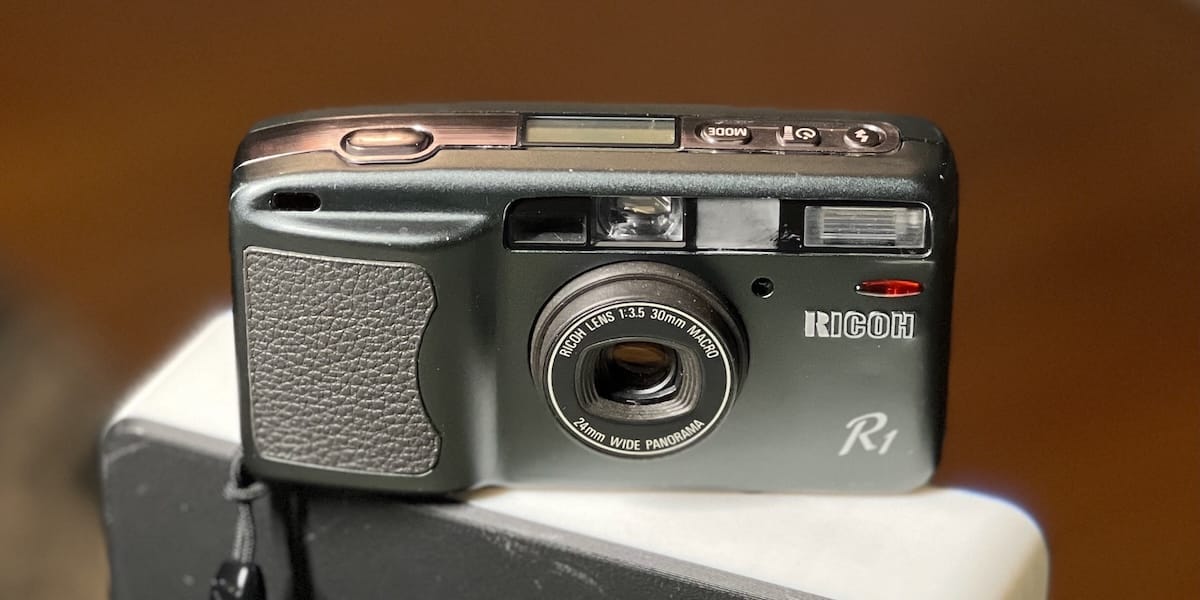
The top displays on these almost never work, so to use the camera’s modes you need some cheat codes.
| Flash Button | Mode Button |
|---|---|
| Normal | Super Night |
| Red Eye Reduction | Infinity |
| Flash Off | Single AF |
| Flash On | |
| Slow Sync |
If the green focus light is flashing, then the camera could not automatically focus so it set the focal distance to 8.2 feet (2.5 meters). If this is a portrait or group shot, then switch to Single AF, place the center spot on the subject, half press the shutter, re-frame the scene, and then take the picture. You almost always need to do this if you are trying to shoot a macro shot - the minimum focus distance is 1.1 feet. If this is a landscape shot, then switch to Infinity focus mode to lock focus at infinity.
In Super Night mode the camera does a double exposure. First it focuses on the background and takes a long exposure shot (up to 2 seconds), then it focuses on the subject and takes a flash shot. It’s best to use a tripod for this mode. If there is no subject then a second exposure will not be attempted.
This little gem comes in two variants: broken and not yet broken. That’s not entirely surprising, these tiny electronic cameras are all around 30 years old at this point. I don’t think that they are likely to be broken because the camera was built to a lower quality though. I think that because they were light, portable, and took great pictures they were used more frequently. It’s more about the number of rolls that went through them. Or, perhaps more appropriately, how many adventures they have been on. More use means more chances to be dropped, sat on, or filled with sand.
The tiny electronics may also be less robust because size was prioritized over robustness. A common issue is that the lens will not pop out when the camera is turned on. Many times this is due to lint or dirt obstructing the gear train. There is a rubber dust seal around the lens to keep things from getting inside the camera, but those are normally degraded now. So, if crumbs from the seal are not getting in the gears, then dust is more likely to get in and do so. The motor seemingly has no extra strength to grind through the grime. When the R1 is working, it is clear why the trade-offs were made.
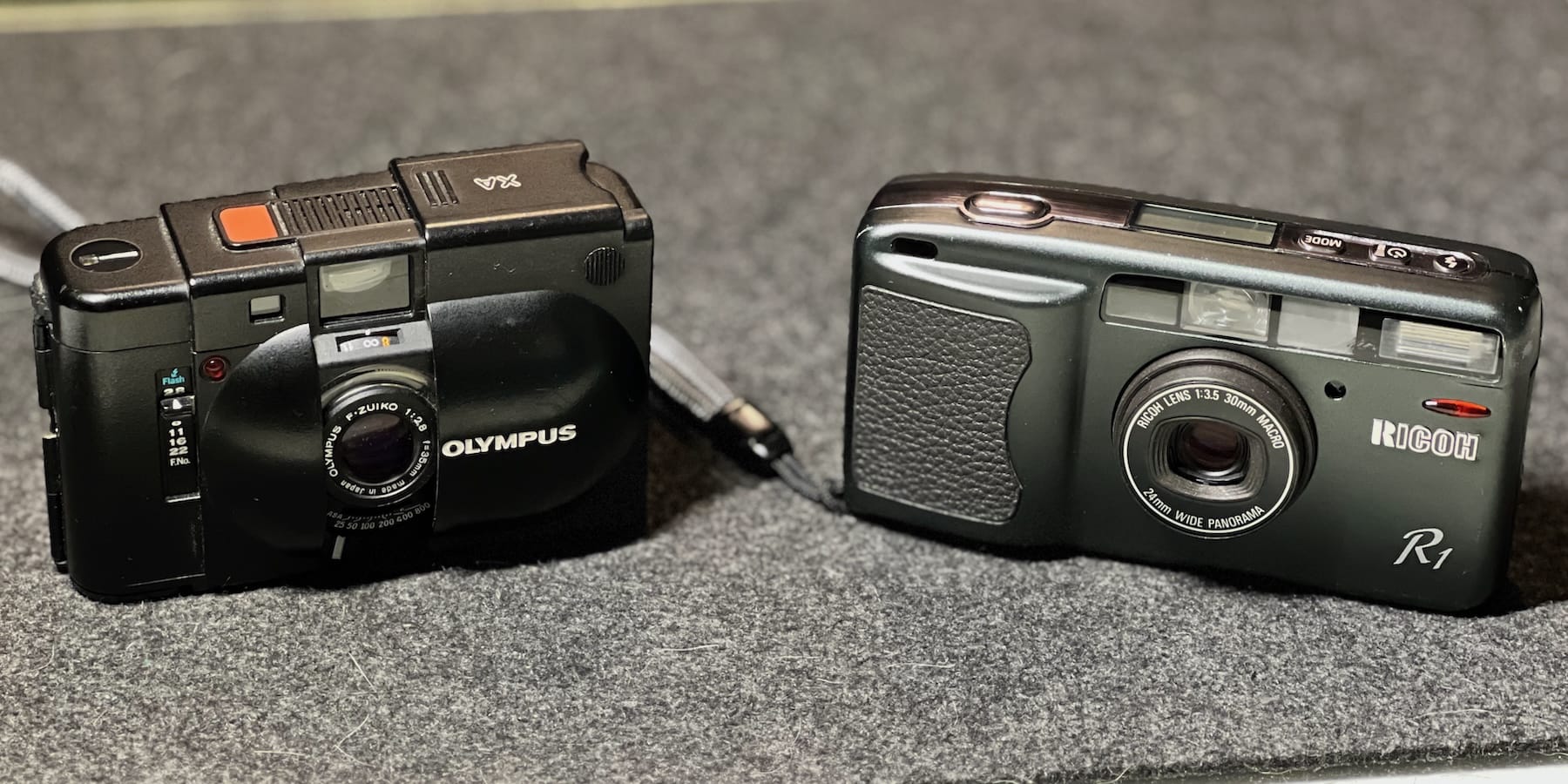
The Ricoh R1 is wonderfully tiny. Compared to another tiny camera, the Olympus XA, it is wider and less deep. The dimensions of the R1 are closer to that of a smartphone than other point and shoots. And, it is the proportions that make it feel so portable. I no longer have the amazing little Minolta TC-1 to compare the R1 against, but from memory, the longer Ricoh feels a tad more pocketable. An R1 is also about a tenth the price of a TC-1, which seems like a steal.
A lot of people buy the Ricoh R1 twice. They purchase one, fall in love with it, and then it breaks. They buy a second R1. When it breaks they cry and maybe buy a GR. I thought, why not just jump ahead and buy two from the get-go. And, why not get it over with and just buy them both pre-broken.
I purchased two broken Ricoh R1s because they seemed broken in different ways. My hope was that I could take two broken cameras and make at least one working. And, I succeeded in getting one mostly working R1. The LCD doesn’t entirely work, of course, but I’m not even sure that counts as broken; does anyone have a Ricoh R1 with a working display? I even replaced the ribbon cable for the display; the viewfinder works now, but the top display is still a bit off. I got the second one working as well, but neither the top screen or the viewfinder work on it.
I wish Ricoh would take a cue from their Pentax line and make these cameras again. Of course people would complain because they aren’t GRs, but such is life. They still make the digital GR, so they should be able to pull off a basic film camera, right? I’d even keep the 40mm lens of the GR IIIx, because who wants a 30mm/24mm convertible lens anyhow.
I’m told the Lomo MC-A is a good substitute, and it looks like a great little camera, but it seems to have those brick-like dimensions. Maybe Lomo could put the MC-A in a panini press. If they do, I hope it is before my as-of-yet-unfixed backup R1 eventually dies, again.
Paradigm Shift
Ricoh had a simple thought. A camera can’t be thinner than a 35mm roll of film. Alternatively, a camera doesn’t need to be thicker than a film roll. That’s what created the ultraslim Ricoh R1 compact camera.
R1 – the new shape in compact cameras. A paradigm-shifting first based on superior Ricoh technology.
The world’s first two-step retractable lens barrel
We harnessed our expertise in zoom camera multistep retraction to create a lens less than 25mm thick. The lens barrel incorporates state-of-the-art plastic technologies for ultraprecision.24mm converter lens system permits panorama shots
You can take more appealing panorama shots because we successfully incorporate a 24mm conversion lens group in regular 30mm lens groups. You effectively get two lenses in one.New operating panel for auto date on the body side
We located the date monitor and the date set buttons on the camera’s left side to enhance the design’s simplicity, and have enlarged the film count number display on the liquid crystal display to make it easier to read.Seven-zone, three-point display passive multi autofocus for superb precision
The R1 uses 128 autofocus sensors grouped in seven zones. Ricoh-developed software evaluates the zones and automatically selects optimal focus. The viewfinder displays the best focus bracketing and other brackets.New
R1
RICOH